Cairo, Egypt: Saqqara Necropolis and Muhammad Ali Mosque
12-22-2025 - still in progress, but here are some highlights.
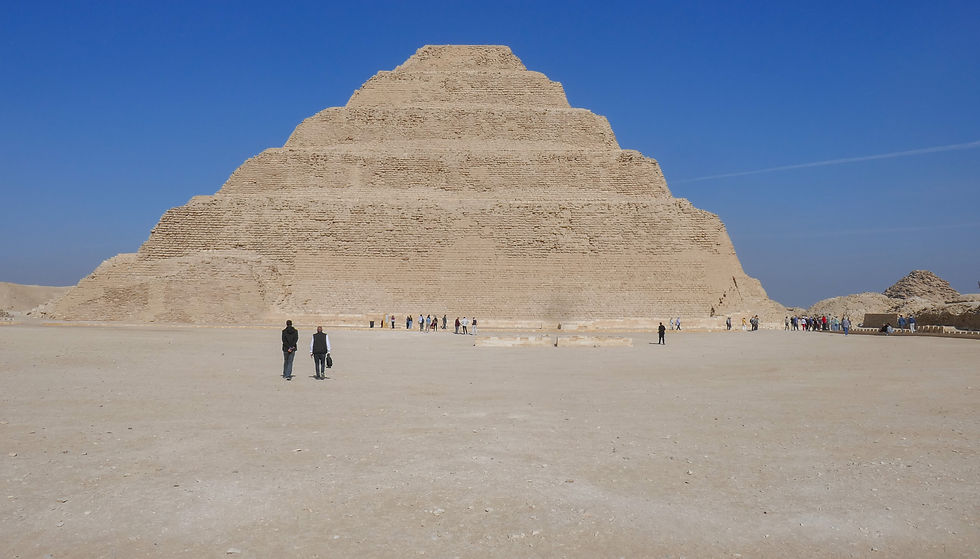
We visited the Saqqara Step Pyramid Complex this morning. Imhotep designed the first pyramid for King Djoser who ruled Egypt in 2667 to 2648 BC during the 3rd Dynasty. This innovation became the inspiration for the other pyramids that became the iconic resting places for the pharaohs of the Old Kingdom of Egypt. Its six steps are six mastabas stacked on top of each other, each a little smaller that the one below it. Mastabas were rectangular structures that covered the tombs of previous kings prior to King Djoser.
Nearby is the "ruined pyramid" of Userkaf, the first king of the 5th Dynasty. To gain status he built it as close as possible to King Djoser's Step Pyramid, but the ravages of time have removed its outer casings making it appear to many as a mound of rubble.

To the right, is the Pyramid of Unas (also called the Pyramid of Teti). Built for Unas, the last pharoah of the 5th dynasty, this is the smallest Old Kingdom Pyramid. However, it contained the famous Pyramid texts containing well-preserved funeral spells used by the Egyptians to provide safe passage to the afterlife.
In the necropolis (city of the dead), we went inside the Tomb of Kagemni. The son-in-law of King Teti of the 6th Dynasty, Kagemni rose to become a powerful visier and had his mastaba decorated by the best artists of the time. Although most the color is now gone, the detailed reliefs are well-preserved and show scenes from Egypian life along the Nile.
We also visited a carpet school that trains local people in carpet making so they can earn money in a trade to augment the income from farming.
Our final stop was the Mosque of Muhammad Ali inside the Saladin Citadel. It is modeled after the Blue Mosque in Istanbul. The inside ceiling was particularly stunning.


Comments