St. Kilda, Scotland
July 11, 2026
We were extremely lucky to have a beautiful day with calm waters for our visit to St. Kilda. Reaching the island can often be treacherous when the sea is rough and landings to the island are often canceled.
We began the day with a morning zodiac ride to go bird watching. The remote islands in the archipelago of St. Kilda are famous worldwide for its sanctuary for over 250,000 pairs of breeding sea birds of many species.
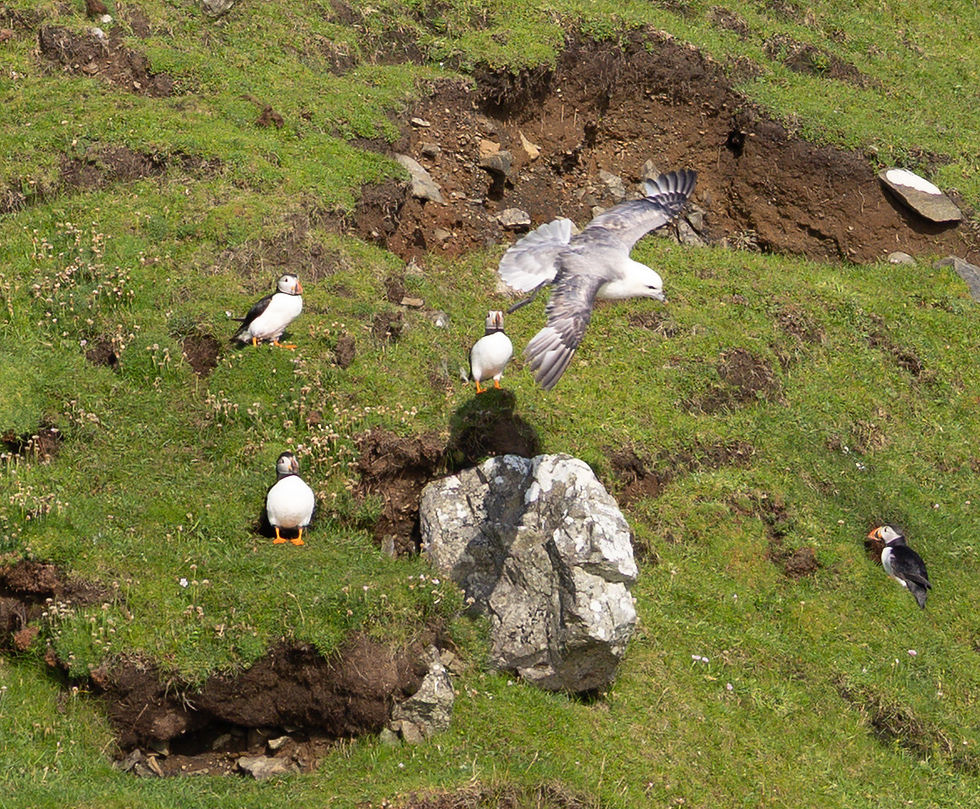
The Isle of Dun hosts Great Britain's largest colony of Atlantic Puffins with over 100,000 breading pairs.


St. Kilda is also famous for being the original home of the Northern Fulmar in Great Britain. Although it has since spread throughout the British Isles and into Northern Europe, a large breeding colony remains on St. Kilda.


Many other breeding birds gather at St. Kilda as well. We were lucky to spot the razorbill, a cousin to the now-extinct Great Auk.


Common Guillemots gathered together on the cliffs. The ones with the distinctive white around their eyes are a bridled variation of the species often called a ringed guillemot.


The bright green streaks on the sea cliffs are from algae and lichen that thrive in the nutrient-rich bird droppings kept moist by the salty spray of the ocean. Because of St. Kilda's remote location it is also pollution-free which allows the extra-sensitive lichen to survive.

Resting above the guillemots, are black-legged kittiwakes and their chicks.


We even saw a few cormorants mixed in with the guillemots.

In addition to the birds, we saw one mammal. A harbor seal was resting on the shore.

The Isle of Dun is very close to the next island in the St. Kilda archipelago, Hrita. A narrow channel separates the two islands.

A small community lived on Hrita for about 4,000 years. They relied heavily on the breeding bird colonies, using them for food, feathers for bedding and trade, and even a particularly smelly oil from the fulmars. Although most island communities rely heavily on fishing for their protein, the seas around St. Kilda are too rough for safe fishing.
Although the last members of the community were evacuated in the 1930s, visitors can still see the cleitan there, storage huts built to cure and store their food. Because of this unique community and the healthy population of sea birds, St. Kilda is one of the few places in the world that has a double UNESCO World Heritage recognition for both its historical and natural importance.

After returning to the ship, we headed to the next St. Kilda island, Boreray. This island and its two sea stacks, Stac an Armin and Stac Lee are home to an the largest northern gannet breeding colony in the world.


Although we didn't get in the zodiacs again, we did do scenic cruising to view the gannets and other birdlife.
The first bird I spotted was the great skua, sometimes called the "Pirate of the Sea" because it snatches food from other sea birds.

Soon though we were spotting gannets all around the ship. They are beautiful birds.

This gannett is "preening". It uses its beaks to both clean and oil its feathers so they stay waterproof. They get the oil from a special gland near their tail.

The wing span of an adult gannet is around 6 feet, as wide as a tall man!


The blue eye ring, icy blue iris, and pale yellow feathers on the head are distinctive features of the gannet.

Their eyes are specially adapted to allow them to dive for fish. Notice how they are positioned more forward than other seabirds. This allows them to have overlapping fields of view giving them a super depth perception that lets them tell exactly how far they need to dive. They also have a special membrane over their eye that covers the eye and protects them from the pressure of the dive while still letting them see in the water.

While adults have white bodies and wings with black tips, the young gannets are have darker wings mottled with white. The darker color provides extra camoflauge and it also signals to adult gannets that the teenager is still young and doesn't pose a threat to their territory.


Comments