Donegal, Sligo, and Knock, Ireland
June 29, 2026
We departed Northern Ireland today and made our way to Galway in Ireland. On the way, we stopped at Donegal Town, Sligo, and Knock.
As we approached Donegal Town, we passed by St. Agatha's Church built from 1869 to 1871. Like many churches in Scotland and Ireland, there was a graveyard on the grounds so that people could be buried on holy ground.

Donegal Town was our first stop for a weaving demonstration. Prominently displayed on the Diamond, the Four Masters monument remembers the Franciscan monks and historians who wrote the Annals of the Four Masters, a comprehensive history of ancient and medieval Ireland through the early 1600s written entirely in Irish in the 17th century.

Our visit to Donegal featured a weaving demonstration at Triona Donegal Tweed. We gathered around a historic hand loom.

There were also sheep wool draped around the loom and a spinning wheel in the corner as a reminder of the process for gathering the yarn for the woven tweeds.
Yarn is wound around the boat shuttle. When the weaver slides the shuttle across the loom through the gap in the warp threads, the yarn unwinds and creates a new row in the fabric.

Occasionally the weaver needs to manually adjust the warp threads to ensure that the herringbone pattern of the tweed stays perfectly aligned with no tangles.

By pumping the treadle with her foot, the weaver powers the loom as it separates the warp threads and moves the larger shuttle back and forth to weave the fabric.

Here, the weaver pulls the beater bar forward to press the thread into the fabric while also operating a fly shuttle to move the shuttle across the loom. This passes the weft thread through the warp and compacts the herringbone weave all at once.

In County Sligo, we stopped at the Mullaghmore Head viewpoint along the Wild Atlantic Way.


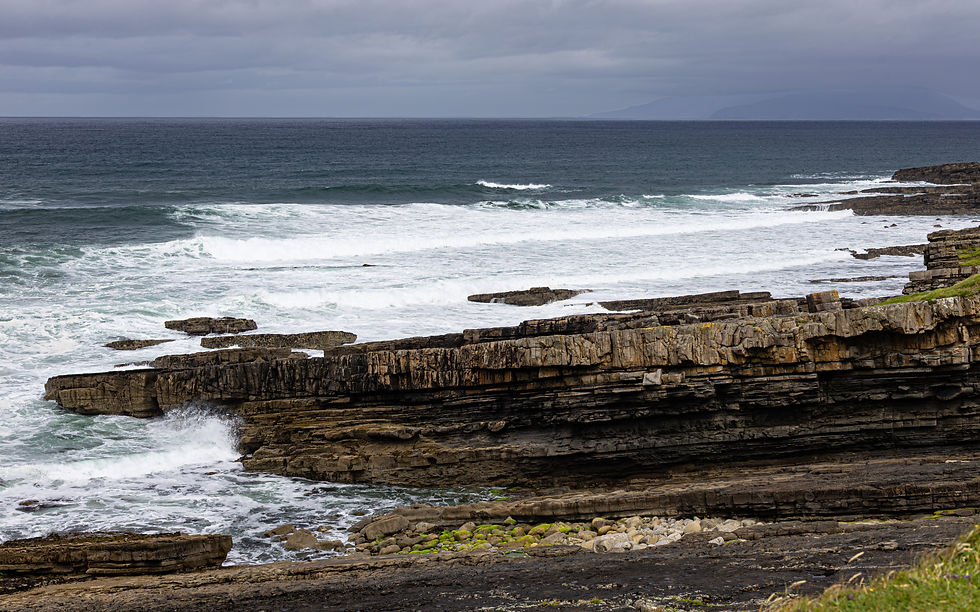

From there, we could also see Classiebawn Castle.

As we entered "Yeats Country" we could clearly see why Ben Bulben is sometimes referred to as Ireland's Table Mountain.

We passed by Mullaghmore Harbour with a different view of Ben Bulben in the background.

A herd of cows was enjoying a beach day at Mullaghmore Beach.


We had two hours to explore the town of Sligo.

It was a fun town to exlore with festive balls and butterflies swaying in the breeze overhead.
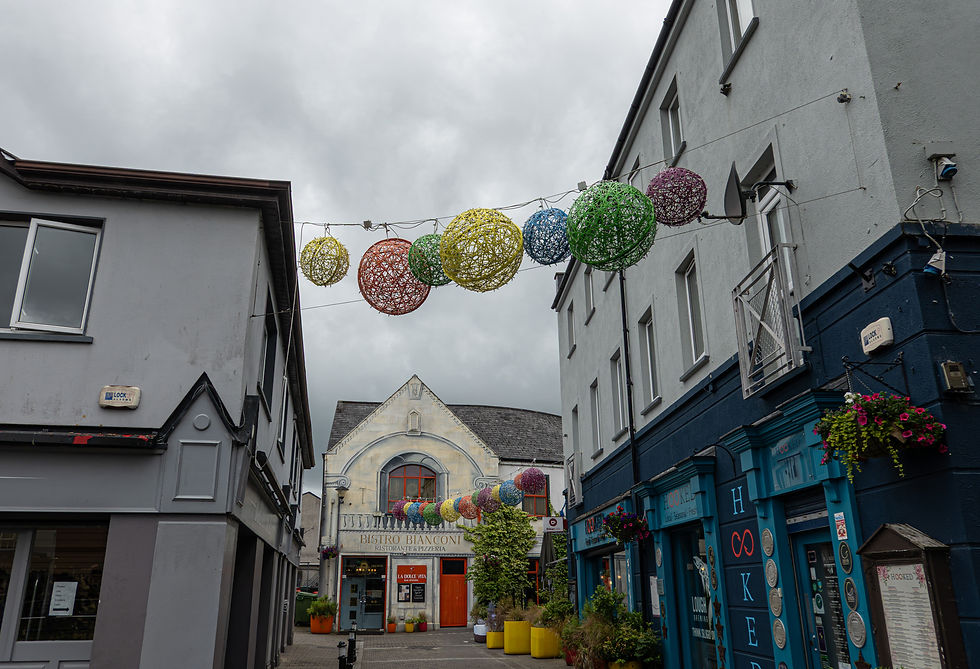

The Nobel Prize winner, William Butler Yeats, grew up in Sligo (although he was born in Dublin). It was the home of his heart and much of his poetry was inspired by its beauty and folklore.

The Yeat's Building is the headquarters for the Yeat's Society.

The Garavogue River runs through Sligo with picturesque bridges and an abundance of swans and other bird life.


I especially enjoyed watching a mother swan and her four cygnets.
The abundance of fossils in the limestone around Sligo means that many stone structures such as the bridges in Sligo have natural fossils in them like this one of solitary rugose coral.

Our final stop before reaching Galway for the night was Knock Shrine. Over a million and half pilgrims visit Knock Shrine every year. In 1879, a silent apparition of the Virgin Mary, St. Joseph and St. John the Evangelist appeared to local men, women and children.
The sculpted figures in the Apparition Chapel recreate what was seen by the 15 official witnesses.
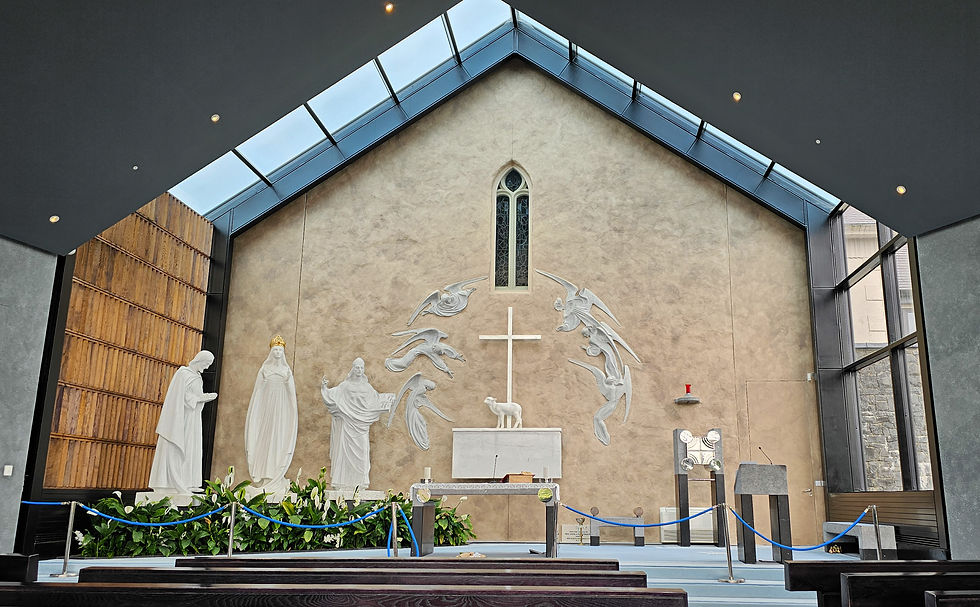
The original stones from the Apparition Gable wall are preserved at the shrine.

The Stations of the Cross at Knock Shrine culminate in a sculpture of the crucifixion of Christ.


The Knock HIgh Cross was erected to remember Pope John Paul II's visit to the shrine in 1979 for the 100th anniversary of the apparition.


Comments