Edinburgh, Scotland - Buildings
Updated: Jul 6
06/17 to 06/21
We flew from Reykjavik to Edinburgh on Wednesday and spent 5 days enjoying this amazing city on our own before our Gate 1 tour began. We used the City Sightseeing hop on and hop off bus for our explorations. They had 3 lines - the red line (primarily the old town with the Royal Mile), the green line, a similar route with some extensions but with a live guide, and the blue line which went into the new town and up into the harbor area with the rivers Forth and Leithe.

Because we saw so much each day, but the routes were repetitive, I am focusing my blog posts on themes rather than the individual days.
The buildings of Edinburgh reflect the rich history of Edinburgh. The start of the tours was at the stop up the hill from our hotel. The first historical building we passed was the Balmoral hotel with its impressive clock tower which is always set 3 minutes fast to make sure people don't miss their scheduled train at the Waverley station. The exception is on Hogmanay when it is reset to the correct time to ring in the new year.

Edinburgh is divided into the medieval Old Town and the New Town constructed during the reign of Queen Victoria. The North Bridge connects the two areas and was the bridge we used to walk from the Royal Mile back to our hotel.

The Scotsman Hotel on the North Bridge was originally the home of The Scotsman newspaper. Like many other buildings in Edinburgh, it is said to be haunted. In this case by a Phantom Printer and a Phantom Forger. They make their presence known by strange clicking, disembodied voices and strange lights.

Here is a view of the Old Town from the Waverly Bridge:

As we toured through Old Town, we passed through the Cowgate Arch beneath the George IV bridge. This gate was used in the Middle Ages to drive cattle to the Grassmarket square where any animal that ate grass could be sold.

Young travelers wanting a cheap place to stay in Edinburgh can stay at this hostel in the Cowgate area.

The St. Patrick Church in the Cowgate area.

Victoria Street connects Grassmarket to the Royal Mile and George IV Bridge. This two-level street with its colorful shops inspired Diagon Alley in the Harry Potter books.

The Lothian Chambers on the George IV Bridge was once the registry office, but now houses the French Consulate-General. It was constructed in 1901 in the Palladian style (late English Renaissance).

The main branch of the National Library of Scotland is also on the George IV Bridge. Its seven sculptures on the outside of the building were carved by Hew Lorimer, a Scottish sculptor. They represent seven branches of knowledge - medicine, science, history, poetry, law, theology, and music.

Surgeon's Hall is located on Nicolson Street and was designed by William Playfair. It now contains three medical museums. Edinburgh University contained a notable medical school here which attracted students from around the world. Both Charles Darwin and Sir Arthur Conan Doyle studied medicine here.
However, during Victorian times, there was a great demand for dead bodies to be used to train its students. This gave rise to the infamous body snatchers who would dig up bodies from graves in kirkyards and sell them to the university. Two notorious men, William Burke and William Hare bypassed the graveyards and instead gathered fresh specimens from their boarding house. Being careful to suffocate their victims without leaving marks. When they were discovered, Hare turned on Burke and Burke was hanged and his body given to the the university where it still resides in the Surgeon's Hall.
The Surgeon's Hall Riot erupted at this site in 1870 with 7 female medical students went to take their first anatomy exams, the first time a British university allowed women to attend medical school

This is the new 1998 addition to the National Museum of Scotland which was attached to the old Victorian building from 1866. Although we entered the museum with the Gate 1 tour for a bathroom break, we did not explore it. One of its well-known exhibits is Dolly the sheep, the first successfully cloned mammal from an adult cell.

Across from the National Museum of Scotland is the entrance arch leading to the Old College of the University of Edinburgh.

Also on Nicolson Street is the Alison House which is home the to the University of Edinburgh's School of Music. It is known for its "Ghost Signs", faded hand painted advertisements, in this case from its past as furniture warehouse.

The Royal Mile (actually slightly over a mile) are the main streets connecting Edinburgh Castle to the Palace of Holyrood. The upper section leading to Edinburgh Castle is known as Castlehill.

At the foot of the Royal Mile is Holyrood, the Scottish Parliament building. It is a modern abstract building that blends oak, steel and granite to reflect the Scottish identity. It opened in 2004 and was definitely one of the more unusual government buildings I've seen.


At the heart of the Royal MIle is St. Giles Cathedral built way back in the 14th century. Although a church has been on that site since 854 AD.

Along the Royal MIle at Castlehill is St. Columba's Free Church of Scotland formed in the 1840s afther the disruption that split the Church of Scotland. It is famous for its red door which can have several possible meanings. These include marking a place of sanctuary, or representing Christ's blood so that passing through the door represents the salvation offered by his sacrifice, or showing that it is a Protestant church (harking back to the red doors where Martin Luther posted his 95 Theses.) A less spiritual meaning could indicate that the mortgage has been paid.

The tall spire in this area is now the Hub which hosts a variety of events in Edinburgh. Surprisingly, this has never been a church even when it was the Tollbooth Kirk. The Church of Scotland used it for their General Assembly.

The current General Assembly for the Church of Scotland is on the Mound which connects Edinburgh's Old Town and New Town.

It is part of the New College designed by Henry Playfair to train ministers for the Free Church of Scotland. It was completed in 1850. Now University of Edinburgh students attend the School of Divinity here. At one time it even temporarily housed the Scottish Parliament.

William Playfair also designed the Royal Scottish Academy of Art and Architecture which was also built on the Mound next to the National Gallery. He used the Neo-Classical style for this building.
The National Gallery is near the Royal Scottish Academy. It was also designed by William Playfair. It first opened its doors to the public in 1859. It contains famous Scottish and international art from the Renaissance to the early 20th century.

The head office of the Bank of Scotland can be found on the Mound. It also houses a free museum dedicated to the history of money and economics. Ironically, the Bank of Scotland was founded by an Englishman and the Bank of England was founded by a Scotsman.

Both the Old Town and the New Town of Edinburgh are a UNESCO World Heritage site. This designation ensures that no changes are made to the historic buildings. The Old Town dates back to the Middle Ages. (Edinburgh has been the Scottish capital since the 1400s.) Later the Georgian New Town was added in 1767 to 1890 using many neo-classical style. It was a marvel of urban planning for its time.
This view contrasts the architecture of the Old Town (in the back) with the New Town (as you move forward to the modern buildings in the front).

A notable steeple in the New Town the New Town Church. When it was built in 1784 it was the St. Andrew's and St. George's West Church. It was an innovative architectural endeavor as it was the first Britain church to have an elliptical floor plan. The steeple was added a few years later in 1787. About 60 years later it became infamous as the site of the Disruption of 1843 when a third of the ministers walked out, leaving the Church of Scotland to form the Free Church. (Thus prompting the construction of the New College in its efforts to train more ministers.

An example of the neo-classical style in the New Town is the HM Register House built in 1788 on Princes Street. It was designed by the famous architect, Robert Adams who was one of the three renowned architects who designed much of New Town. William Playfair and James Craig, also a talented city planner were the other two. The Register House is now home to the Scotland People's Center where you can research your Scottish ancestry.
Outside the building is a statue of the first Duke of Wellington, Arthur Wellesley, who rode his battle horse, Copenhagen, against Napoleon in the Battle of Waterloo.

The unicorn is the national animal of Scotland, the only mythical national animal. We saw them throughout Scotland, including above the door of the Merchant's Hall in New Town.

This office building built in 1892 is located in St. Andrew's Square was originally built for Prudential Assurance. St. Andrew's Square is a notable area in New Town named after the patron saint of Scotland.
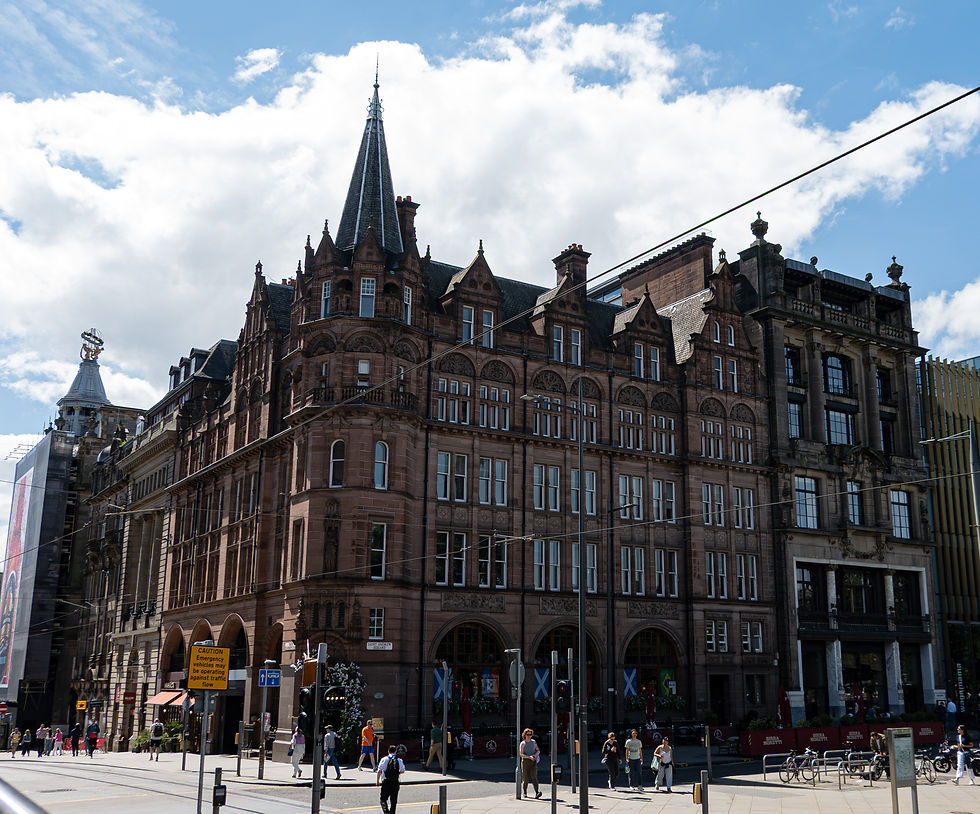
Calton Hill in New Town contains many notable monuments including the Governor's House which is the final remnant of Scotland's largest prison, Calton Jail. The obelisk on the left is the Political Martyr's Monument.

Rober Burn designed this 1816 monument on Carlton Hill in memory of Admiral Lord Nelson's final victory at the Battle of Trafalgar where he died. The monument is an upturned telescope to symbolize his career in the navy.

On the west end of Princes Street is St. John's Scottish Episcopal Church in known for its brilliant blue door. People debate the significance of the blue. Some speculate that it stands for the purity of the Virgin Mary, while others contend it stands for Scotland. It may be used to ward off evil spirits or represent the church's independence from the Church of England. Blue doors also could indicate a mortgage-free building. However, no one knows for sure why William Burn, the architect who designed the church, included the blue door.

Nearby on Princes Street is the Caledonian, a stately hotel built over 100 years ago in 1903 by the Caledonian Railroad Company to proved a luxurious hotel for its passengers. It is still a 5 star hotel today and has hosted many famous guests such as Charlie Chaplin, Queen Elizabeth II, Nelson Mandela and President Obama. Our live guide on the green line told us that Taylor Swift stayed at a suite in this hotel when here on her Eras Tour in 2024. According to the guide no one who was not a part of Taylor's retinue was allowed to stay in the hotel while she was there. However, I cannot find verification for that.

The site of the Parish Church of St. Cuthbert on Princes Street dates back to the 7th century. Since then it has been destroyed and rebuilt at different times. The steeple is from 1789 when the church was rebuilt in the Georgian style after being destroyed by Oliver Cromwell's purge of Catholic churches in 1650. The church itself was rebuilt again in 1894 but they retained the steeple.

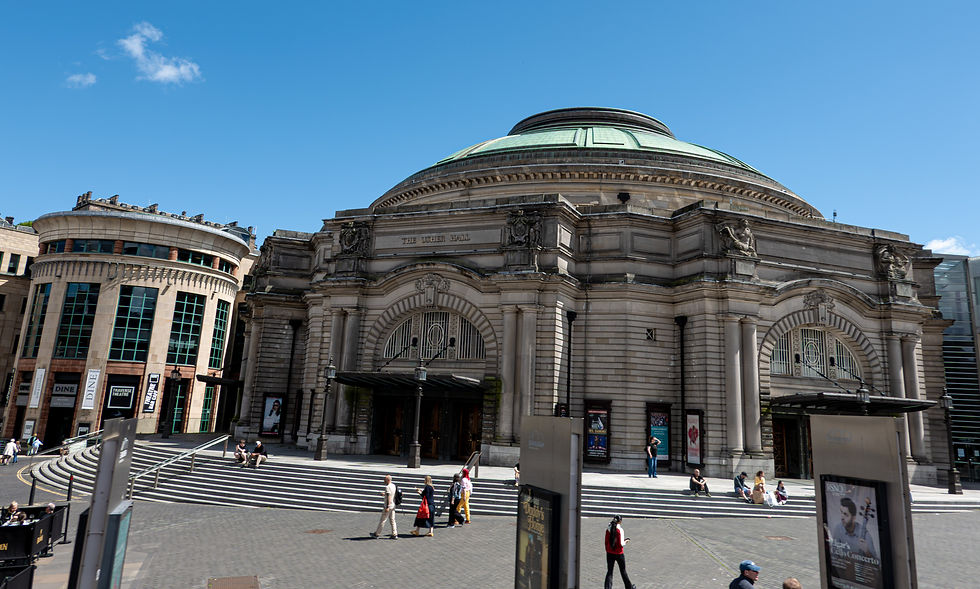
Usher Hall on Lothian Street is the place to go for concerts in Edinburgh. It is well-known for its fantastic acoustics.
After each day of touring, we returned to our hotel, the Courtyard by Marriott in Edinburgh.

It is located right next to the Edinburgh Playhouse. I enjoyed a delicious steak and ale pie at the Royal Theater Bar.


Comments