Edinburgh - Statues
6/17 to 6/22 2026
In addition to the historic buildings, we also saw many interesting sculptures and other monuments in our explorations of Edinburgh.
The Scott Monument is a Victorian Gothic memorial to the famous Scottish writer Sir Walter Scott who wrote Ivanhoe, Waverly, and Rob Roy. In addition to the large central marble statue of Sir Walter Scott and his deerhound, Maida, there are 64 to 68 smaller statues representing characters in his novels. It is the largest statue to an author in the world.
Next to the Scott Monument is a statue of David Livingstone, best known for his exploration of Africa. He is shown with a lion skin wrapped around him to symbolize the time he survived a lion attack.

This 24-foot Celtic cross is the Dean Ramsay Memorial on the grounds of St. John's Scottish Episcopal Church built in remembrance of a 19th century Edinburgh philanthropist. Its panels contain Celtic symbols and Biblical scenes.

On the North Bridge is the King's Own Scottish Borderers Memorial dedicated to the officers and soldiers who died in campaigns in the late 19th and early 20th century such as the Boer Wars in South Africa.

This is a statue of Allan Ramsay, a Scottish poet and playwright who was also a wig maker. He is shown in a night cap instead of a wig to show that he is a wig maker.

This statue of Dr. Thomas Guthrie, a Scottish preacher, shows him with a young boy to highlight his work founding schools for poor children.

Sir James Young Simpson discovered that chloroform could be used as an anesthetic and promoted its medical use. However, his attempts to use it during childbirth met with strong opposition until Queen Victoria used it when giving birth to her 8th child. She knighted Dr. Simpson and made him her personal physician.

Outside the Scottish National Museum stands the statue of William Henry Playfair, one of Scotland's greatest architects. He designed many of the buildings during the construction of Edinburgh's New Town.

There is also a statue for the publisher, William Chambers, outside the museum.

In Parliament Square a statue commemorates the "Father of the British Fire Service", James Braidwood. He founded the first fire brigade in the world in Edinburgh in 1824.

This statue of the scientist James Clerk Maxwell has been "coned." This has become a Scottish tradition since students in Glascow kept putting a cone on the head of Duke of Wellington statue. Since then the tradition has recently spread to Edinburgh, and we saw several statues bearing the cones. The tradition continues despite the risk of harming the statues.

This time in Edinburgh, they missed the Duke of Wellington's head, but his horse bears the cone on its hooves.

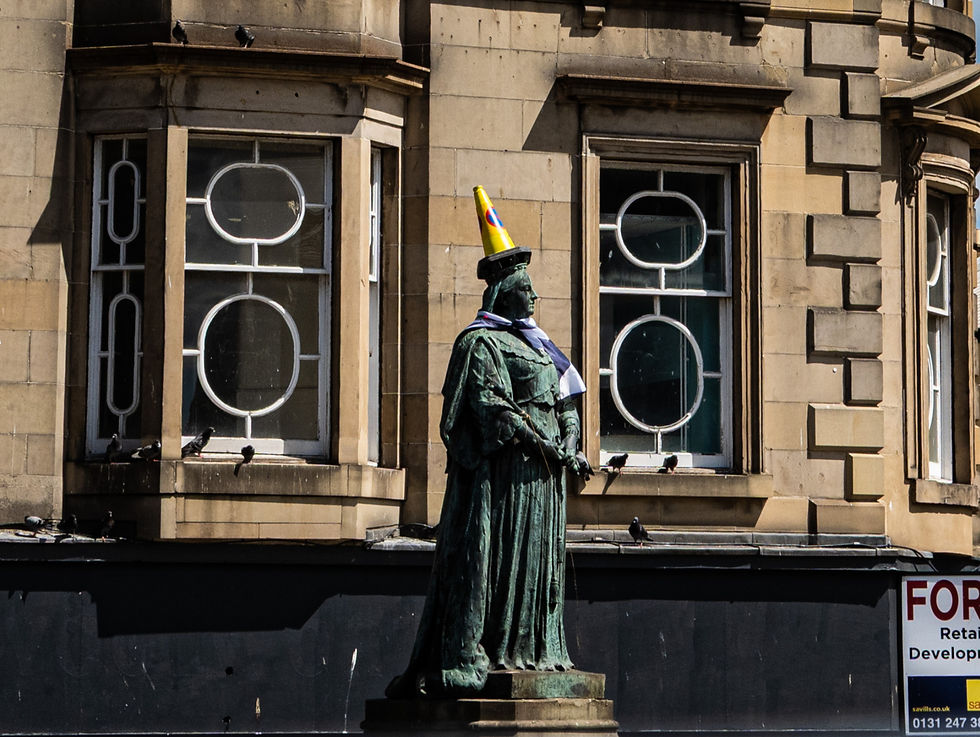
Queen Victoria's statue way out on the Leith Walk also fell victim to the cones.
This monument to Catherine Sinclair, a Scottish children's writer, uses the same style as the Scott monument but on a smaller scale.

This statue of King George IV was built in 1822 after the king visited Edinburgh, the first English monarch to come to Scotland in a state visit for 200 years!

This statue of Henry Dundas sits atop a 150 foot column. He was not a well-liked man by many in Edinburgh and is considered to be responsible for delaying the abolition of slavery in the United Kingdom.
The Scottish poet Robert Fergusson died young at 24, but lives on with his poem "Auld Reike". He inspired the later famous Scottish poet, Robert Burns.

Not far from our hotel was a statue of Sherlock Holmes to honor the famous author, Sir Arthur Conan Doyle.


Comments