Glascow, Scotland
June 26, 2026
We started the day with a Gate 1 city tour of Glascow. Mostly it was a bus tour, but we did have stops at the Glascow Cathedral and the Glascow Botanic Gardens (although the latter was mostly a bathroom stop with very little time to actually explore the gardens).
The Glascow Cathedral of St. Mungo was the only mainland Scottish medieval cathedral to survive the Scottish Reformation led by John Knox. They were iconoclasts who believed the images and statues in Catholic churches should be destroyed. They assaulted and destroyed many Catholic churches throughout Scotland in the 16 century. However, the citizens and trade guilds of Glascow banded together to protect their cathedral. They removed the statues, altars and other Catholic symbols, and convinced the Protestant reformists to use it as a Protestant church.
The Glascow Cathedral was first consecrated in 1136 but destroyed by a fire and rebuilt in 1197. Extensive renovations were down in the 13th and 15th centuries creating the church we see today.

Ironically, just to the east of the Glascow Cathedral, is the Glascow necropolis with a tall monument to John Knox towering over the graves.

The interior of the cathedral is stunning.

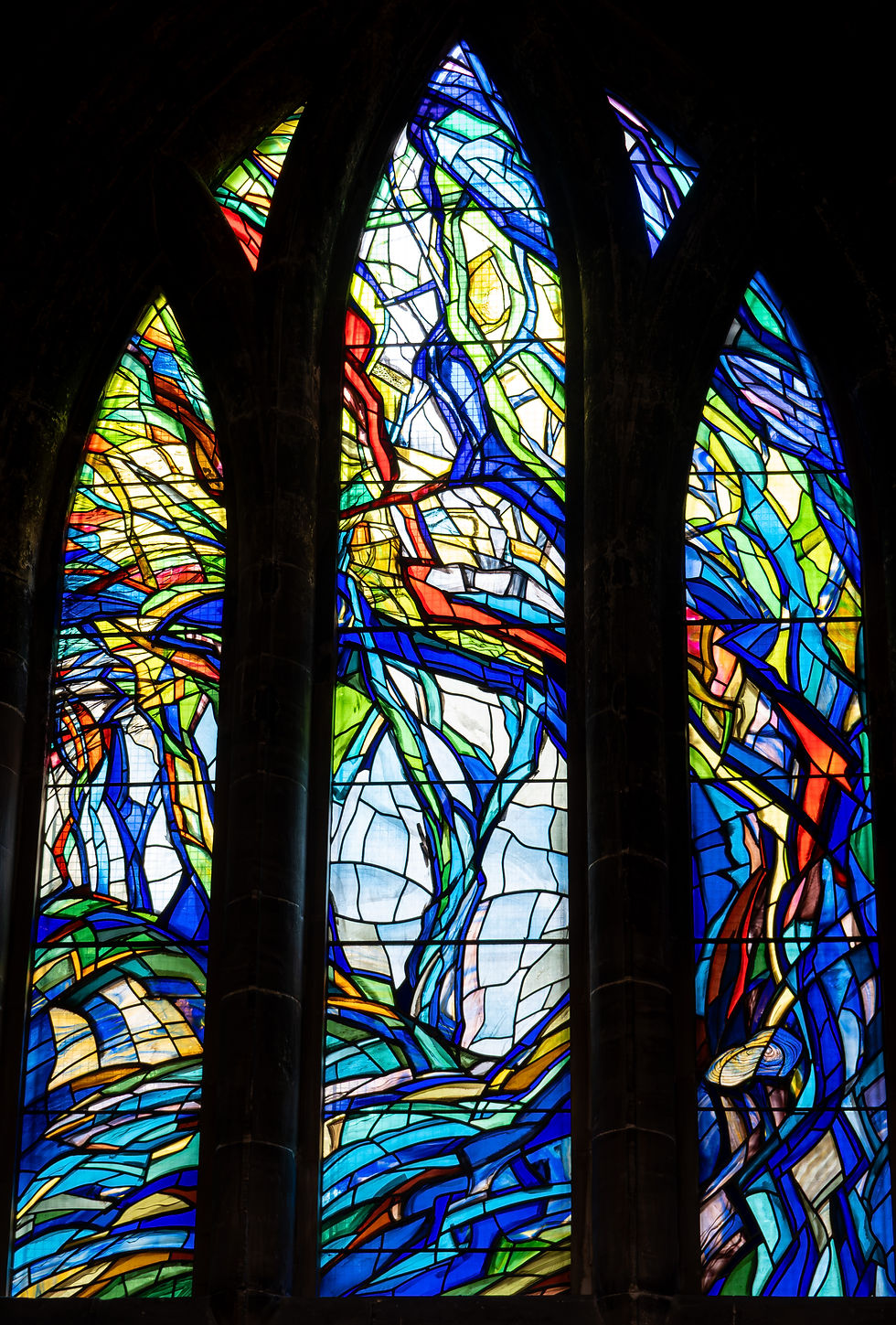
It is filled with exquisite stained glass from the 19th to the 21st century. All of the original stained glass from the medieval church was removed and replaced with plain glass to preserve the church during the reformation.


The side walls were also lined with monuments of war heroes.
This beautifully carved chair and desk is a memorial to the Royal Navy Volunteer Reserve members who gave their live in World War I and World War 2.

There was a beautiful baptismal font carved with intricate Celtic knotwork.

This eagle lectern was made in France in the 17th century.

There was a pew end carved in the shape of a unicorn, Scotland's national animal.

The Law Monument was built in the 17th century to honor Archbishop James Law who was the Archbishop of Glascow from 1615 to 1632.

Many of the wooden chairs and pews had coats of arms to honor public organizations and historical figures.

The lamp posts near the Cathedral feature the four symbols from the city's coat of arms: the bird, the bell, the fish with a ring in its mouth, and the tree. They are connected to the riddle rhyme:
Here is the bird that never flew.
Here is the tree that never grew.
Here is the bell that never rang.
Here is the fish that never swam.
This riddle recalls the miracles of St. Mungo, Glascow's patron saint whose tomb is in the Glascow Cathedral. The bird that never flew is a pet robin killed by his classmates that the saint brought back to life when he was a child. The tree that never grew is the holy fire he relit with frozen branches after he fell asleep on his watch and let the original fire go out. The bell that never rang was the bell St. Mungo used to call the people to prayer. It was given to him by the Pope. This fish that never swam was the salmon that he used to rescue a Scottish Queen Languoreth. She had lost her wedding ring and the king thought she had been unfaithful. The saint ordered one of his follows to catch a fish in the River Clyde and there was the ring in the fish's mouth.

Outside the cathedral, was the Glascow Royal Infirmary built during Queen Victoria's Diamond Jubilee (the 60th anniversary of her becoming queen). It features a prominent statue of her above the main doorway.


Across from it and in front of the cathedral is at statue of the Scottish explorer and missionary, David Livingstone, who is most well known for his travels in Africa where his heart his buried.

There is also the statue of James Lumsden, the Lord Provost of Glascow in the 1840s.

Also near the church, we admired "Rennie" who is part of a 2026 art trail called "Scotties in the City" to help raise money to fight cancer. This particular Scottish Terrier was designed by Gayani Ariyaratne to honor the Scottish architect and painter, Charles Rennie Mackintosh, who died from tongue and throat cancer in 1928. The money for the charity is raised by corporate sponsorship of the statues and a final "End of the Trail" auction of the 40 statues. Rennie's body is painted with thistles and other symbols of Scotland.

On our way to the cathedral, we had also passed by the gate to St. NIcholas Garden which featured intricated metalwork of abstract figures representing St. Nicholas and his traditional attributes.

Our bus tour was supposed to include George Square which has many important bronze statues. Unfortunately, the square was still undergoing renovation and we could not enter. However, we did see the back of the towering statue of the famous Scottish writer, Sir Walter Scott amidst the scaffolding.

The Tollbooth Steeple at Glascow Cross was built in the early 1600s. It is all that remains of the once thriving Tollbooth civic center.

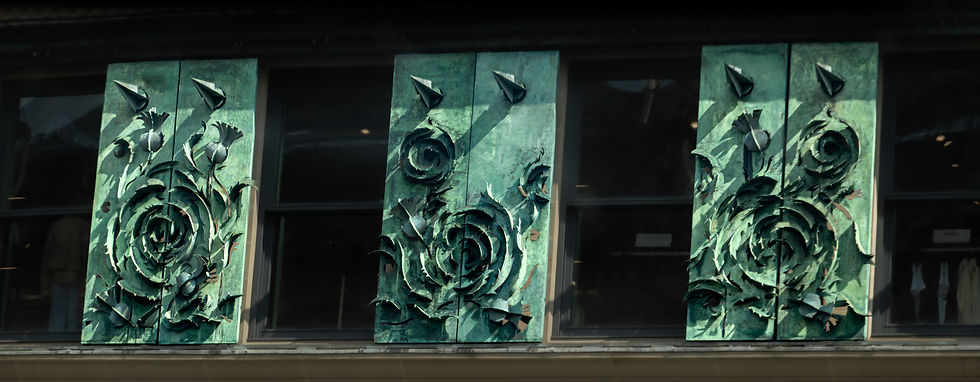
"Grasp the Thistle" by Jack Faulds Sloan was created as part of a public art and architecture project to restore the damage caused by the 1992 fire. This sculpture features the Scottish Thistle, the national flower of Scotland. Legend says that Scotland was saved from a Viking attack when one of the attackers stepped on a thistle and yelled out, alerting the sleeping Scots of the night time attack. The prickly thistle also symbolizes Scotlands resilience. Sloan used the Glascow Style, an art nouveau style pioneered by Charles Rennie MacIntosh who the Scottie dog from earlier was named after.
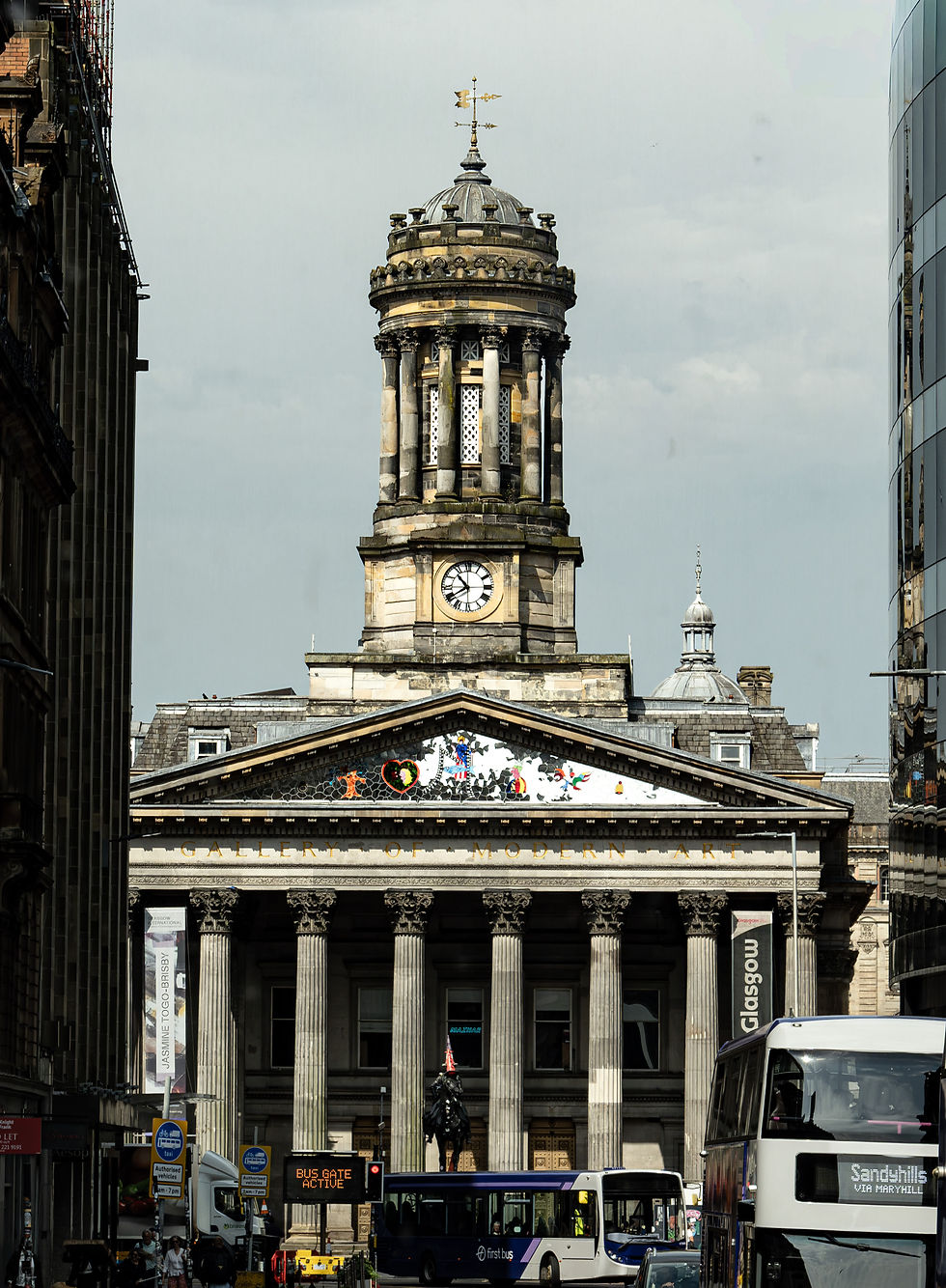
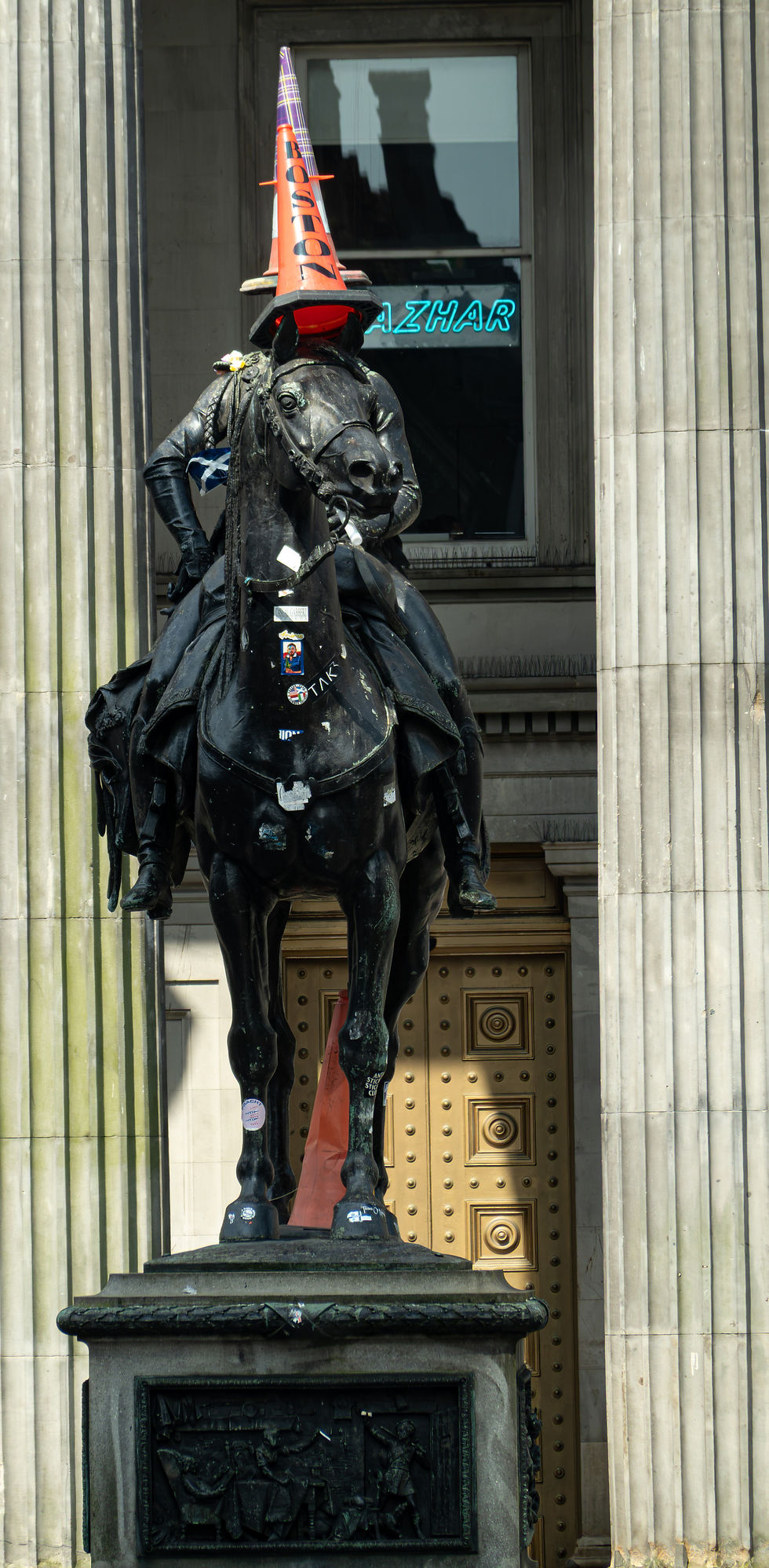
Outside the Gallery of Modern Art, we see the statue of the Duke of Wellington. Both he and his horse are sporting cones. The Duke has the dubious honor of being the origin of the statue coning which has become a college student tradition in Glascow and Edinburgh. In the 1980s students from the university first placed the cone upon his head and continue to replace it despite city efforts to stop them. It has now become an accepted tradition and the poor duke is rarely seen without his cones.
Our last stop was at the Glascow Botanic Gardens. There was only time for a brief walk around before we had to meet the bus again.

Brent went in and explored the Kibble House, the glass greenhouse in the gardens.

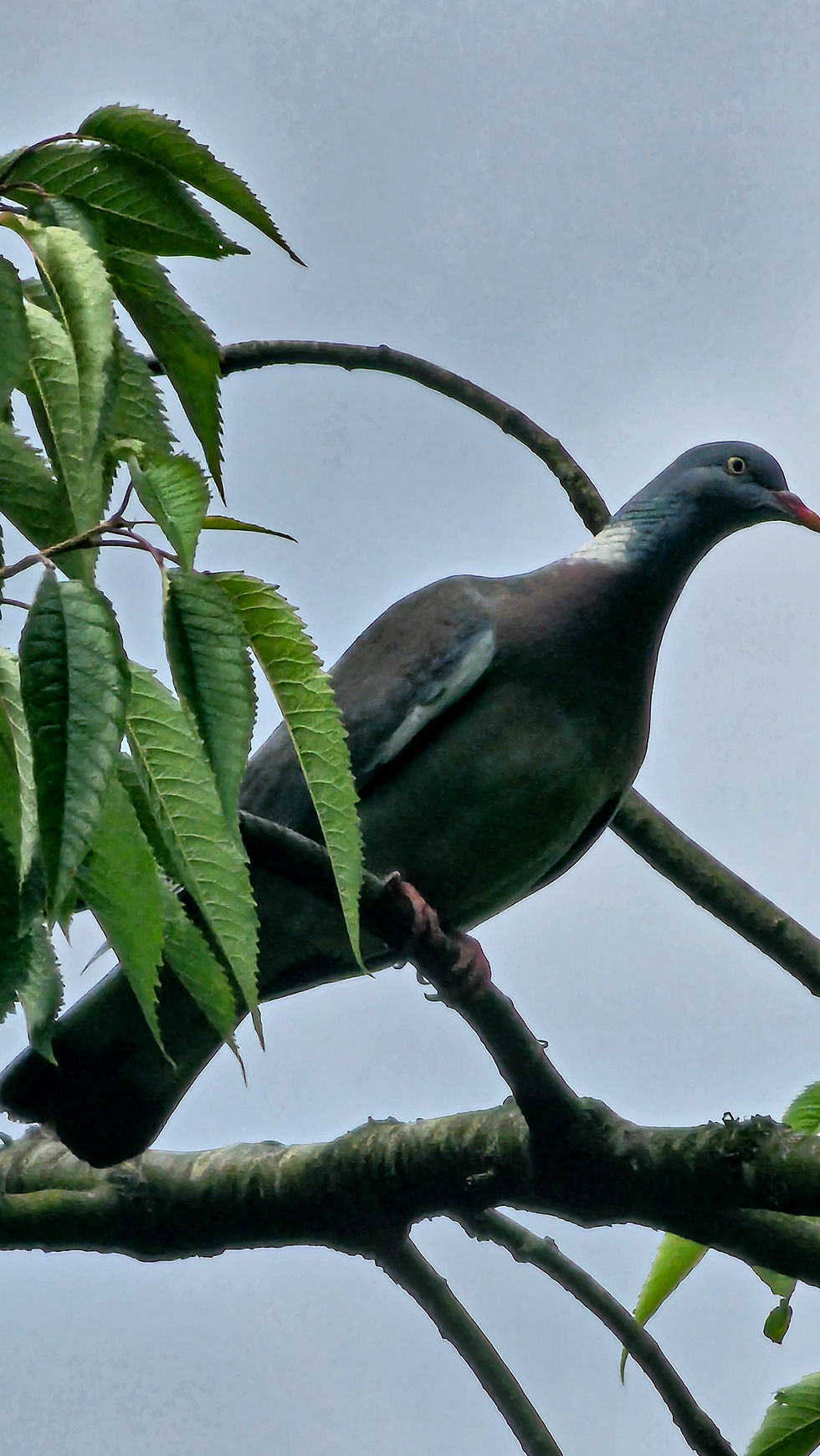
He also spotted a pretty common wood pigeon in a tree.
The Glascow coat of arms was on a building in the gardens featuring the four symbols of St. Mungo's miracles.

On the way back to the hotel, we passed by the "Squinty Bridge" over the River Clyde (officially named the Clyde Arc but given the nickname for the asymmetry of the arc).

The Finnieston Crane is one of only 11 giant cantilever cranes remaining in the world. It is a landmark symbolizing Glascow's ship building industry.

The Riverside Museum is a museum of transportation. The unique design of its roofline reflects the flow of the River Clyde.


Comments